Light Your Rhythm

Finnegan Flynn
| 15-04-2026
 · Art Team
It is 10:00 PM. You are winding down for the evening, perhaps reading or scrolling through your phone, but your ceiling is blazing with a sharp, 6000K cool white glare.
To your eyes, it is just a bright room; to your brain, it is a biological emergency.
Under that harsh blue-toned light, your pineal gland is essentially paralyzed, convinced that it is high noon in the middle of a desert. You are effectively living in a state of self-imposed jet lag. While you are trying to sleep, your internal clock is screaming "stay awake," all because your light bulbs are stuck in the wrong time zone.
The Biological "Blue Light" Trap
Our bodies evolved under the sun, a light source that changes its color temperature throughout the day. The blue light found in high-Kelvin (K) bulbs mimics the midday sky, which suppresses melatonin—the hormone responsible for telling your body it is time to rest. When we expose ourselves to "cold" light late at night, we are tricking our nervous system into a state of high alertness.
This mismatch is why you might feel "tired but wired." You are physically exhausted, yet your brain remains in an analytical, daylight-focused mode. Breaking this cycle requires a fundamental shift in how we perceive interior lighting: it is not just for visibility; it is a chemical trigger for our biology.
The Functional Temperature Map
To regain control over your circadian rhythm, you must assign specific color temperatures to specific tasks and zones within your home. Lighting is a tool that should be calibrated for the human activity occurring beneath it.
1. The Workspace (4000K): This is the "Focus Zone." Neutral white light provides high contrast and keeps the mind alert without being as aggressive as 6000K. It is perfect for home offices and kitchens where precision is required. 2. The Dining Area (3000K): Warm white light is the key to a pleasant meal. This temperature enhances the natural colors of food, making dishes look more appetizing and creating a social, relaxed atmosphere. 3. The Bedroom and Lounge (2700K): This is the "Sleep Zone." Extra-warm light mimics the soft glow of a sunset or a candle. It signals the brain to start producing melatonin and prepares the muscles for relaxation. 4. Transition Spaces (3000K - 3500K): Hallways and bathrooms should avoid harsh spikes in temperature to prevent "waking up" the brain during a midnight trip to the sink.
Simulating the Digital Sunset
The most effective way to manage your internal clock is through a smart lighting system that supports a "Sunset Mode." Instead of a binary "on or off" switch, these systems gradually shift both the brightness and the color temperature as the evening progresses.
Imagine your lights starting at a crisp 4000K at 5:00 PM, slowly dipping to 3000K by dinner, and settling into a dim, amber 2200K by 9:00 PM. This mechanical simulation of the setting sun allows your body to enter a "pre-sleep" state naturally. It bridges the gap between the frantic energy of the workday and the silence of the night. By the time your head hits the pillow, your hormonal profile is already aligned with the darkness outside, leading to deeper, more restorative rest.
Hard Rules for Soft Lighting
Beyond Kelvin numbers, the physical placement of light also impacts your sleep hygiene. During the day, overhead lighting is fine as it mimics the sun above. However, in the evening, try to switch to lamps placed at eye level or lower.
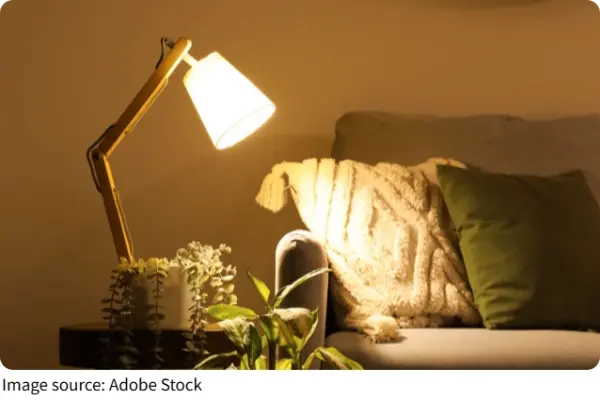
Lower-placed light sources are less likely to hit the specific receptors in the lower part of the retina that are most sensitive to blue light. By using floor lamps and bedside lighting with warm-toned shades, you create a visual environment that feels protective and cozy rather than exposed and clinical.
We often think of technology as something that distances us from nature, but smart lighting allows us to bring the natural cycle of the sun back into our modern, indoor lives. We were never meant to live in a perpetual noon. Respecting the "time" of your light is an act of self-care that pays dividends in mental clarity and physical health. When you align your home with the rhythms of the earth, you stop fighting your own biology. The next time you reach for the light switch, ask yourself: what time does my brain think it is? Sometimes, the best way to move forward into a productive tomorrow is to let the light fade into a warm, amber today.