Crab: Side Step

Owen Murphy
| 02-06-2026
 · Animal Team
Hey, Lykkers! have you ever stood near a beach and watched a crab dart across the sand, moving sideways so quickly it almost looks unreal? At first glance, the movement seems awkward, even clumsy.
After all, why would an animal evolve to move sideways instead of straight ahead? Yet beneath that quirky shuffle lies an impressive survival strategy shaped by millions of years of evolution.
A Body Built for Sideways Speed
To understand why crab move sideways, it helps to look closely at their body design. Unlike long-bodied marine creatures such as lobsters or shrimp, crab have broad, compact frames with legs positioned outward along the sides of the shell. Their joints bend in a way that naturally favors lateral movement. In simple terms, their anatomy makes side-stepping more efficient than walking forward.
A crab’s legs act almost like coordinated paddles. Instead of competing for space while stepping straight ahead, the limbs move in synchronized patterns that allow rapid bursts of speed across unstable surfaces. This arrangement becomes especially useful when escaping danger. On an exposed shoreline, hesitation can mean becoming dinner for birds, fish, or larger predators.
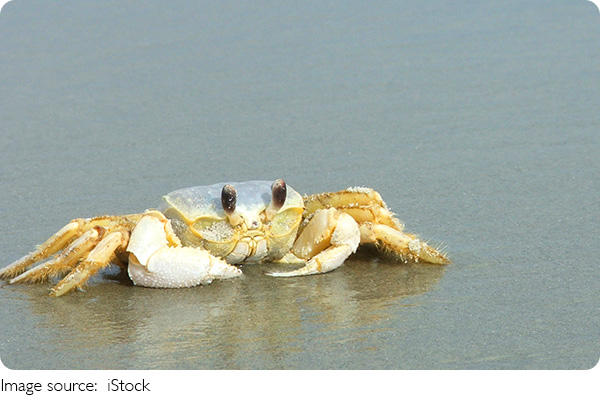
A fast sideways sprint allows crab to disappear into burrows, under rocks, or back into water within seconds. Some of the fastest species, particularly ghost crab found on warm sandy beaches, can move at remarkable speed. Their quick sideward bursts help them outrun threats and search for food.
The Missing Tail That Changed Everything
Crab were not always shaped the way they appear today. Scientists believe modern crab evolved from crustacean ancestors with long, muscular tails similar to those of lobsters and shrimp. Those tails are useful underwater because they help power sudden backward escapes. A startled lobster, for example, curls and flicks its tail to shoot backward through water.
However, that same structure becomes a disadvantage on land or along rocky coastlines. A large tail adds weight and limits agility. It also affects how the body balances while moving. Forward walking becomes less efficient when several long legs must coordinate in narrow spaces. Over evolutionary time, crab underwent a major redesign.
Their tails gradually shrank and folded beneath the body into a compact abdominal flap. This process reduced unnecessary bulk and created a lighter, flatter shape better suited for crawling, climbing, and rapid movement across uneven environments. Without a large tail interfering, crab legs gained greater freedom to move laterally. Sideways travel became quicker and more practical than traditional forward motion.
Why Forward Walking Is Often Less Efficient
Imagine trying to walk quickly while your legs constantly brush against one another. That challenge helps explain why sideways movement works so well for crab. A crab limbs are attached in paired rows stretching from both sides of the shell. If these animals relied mainly on forward walking, leg interference could reduce efficiency and slow reaction time. By shifting sideways, crab avoid this mechanical problem.
Each limb pushes in a direction that supports balance and speed while minimizing collisions between neighboring legs. The result is surprisingly effective locomotion. On loose sand, slippery rocks, or muddy flats, crab often maintain stability better than creatures with more traditional movement styles. This advantage matters because many crab live in unpredictable coastal habitats where surfaces constantly change due to tides, waves, and shifting sediment.
Not Every Crab Follows the Same Rule
Although sideways walking is common among crab species, nature rarely follows a single pattern. Some crab prefer more forward movement depending on their environment.
Spider crab, with long legs ending in pointed tips, are adapted for climbing rocky surfaces and navigating difficult terrain. Forward movement provides better control when gripping uneven structures.
Hermit crab offer another variation. Carrying borrowed shells changes their balance and center of gravity. Forward walking becomes more practical when transporting a portable shelter. These differences show that movement evolves based on survival needs rather than a fixed design.
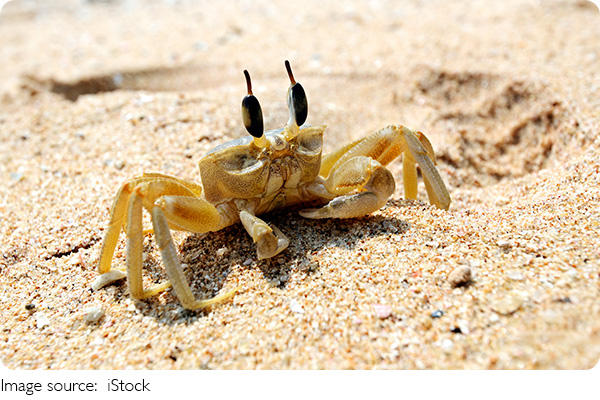
It is easy to overlook a crab scuttling sideways across a beach, but that motion represents a remarkable evolutionary solution. Their flattened body, reduced tail, and uniquely arranged limbs have made crab highly adaptable survivors capable of thriving between land and sea. Sideways movement improves speed, enhances balance, and allows fast reactions in environments where every second matters.